Stop the Leak: How to Turn First-Time Buyers into Lifetime Customers
Don't let your hard-won customers slip away after their first purchase. Learn essential conversion marketing and usage strategies to drive repeat sales, build loyalty, and master cross-selling and upselling campaigns.
💡 The Hardest Part Is Over: You've Got the Customer
You've done the heavy lifting. You invested time, money, and creativity in crafting a compelling message, running ads, optimizing your website, and driving a stranger through your complex acquisition funnel. A customer has made their first purchase. Congratulations!
But here is where many small business owners make a critical mistake: they treat the first sale as the finish line.
In reality, the first purchase is the starting pistol for the real race: customer retention. This phase—post-acquisition marketing—is often ignored, yet it holds the key to scalable, profitable growth. A customer who buys once is merely an experiment; a customer who buys twice or more is a proof point for your business model.
📉 Why First-Time Buyers Often Don't Return
It’s tempting to assume that a great product is enough. "If they liked the first item, they'll be back," we think.
While your product quality matters, the single biggest barrier to a repeat purchase isn't usually disappointment; it's inertia and forgetfulness.
The first purchase is often driven by a specific, immediate need. Once that need is met, the customer moves on, distracted by the next problem, the next shiny object, or the next competitor's ad. They haven't yet formed a habit or a relationship with your brand. They are in a pivotal, but fragile, state.
This is why a dedicated conversion marketing strategy is essential after the sale. Your job is to make the next step easy, intuitive, and valuable.
🎯 Marketing Action: Influencing the Return
Your post-acquisition marketing efforts must focus on two main objectives:
- Reinforce the value of the first purchase.
- Introduce the value of the next product or service.
1. Drive Usage and Value Confirmation
Immediately after the sale, your marketing must pivot from selling to helping.
- Welcome Series: Don't just send a receipt. Send a series of emails (or texts/in-app messages) focused on how to get the most value from their recent purchase.
- Example for a coffee company: Email 1: "Your Brewing Quick-Start Guide." Email 2: "3 Recipes to Try This Week."
- Customer Service as Marketing: Ensure your support team is trained to be proactive. High usage is the single best indicator of a future repeat purchase.
2. Strategic Next-Purchase Campaigns
Once you’ve confirmed they’ve started using the product, you can introduce other options:
- Cross-Selling Campaigns: Suggest related, complementary products. (e.g., "You loved our espresso roast, now try our decaf blend.")
- Upselling Campaigns: Offer an upgrade or a premium version of what they bought. (e.g., "Upgrade to our annual subscription for 20% savings.")
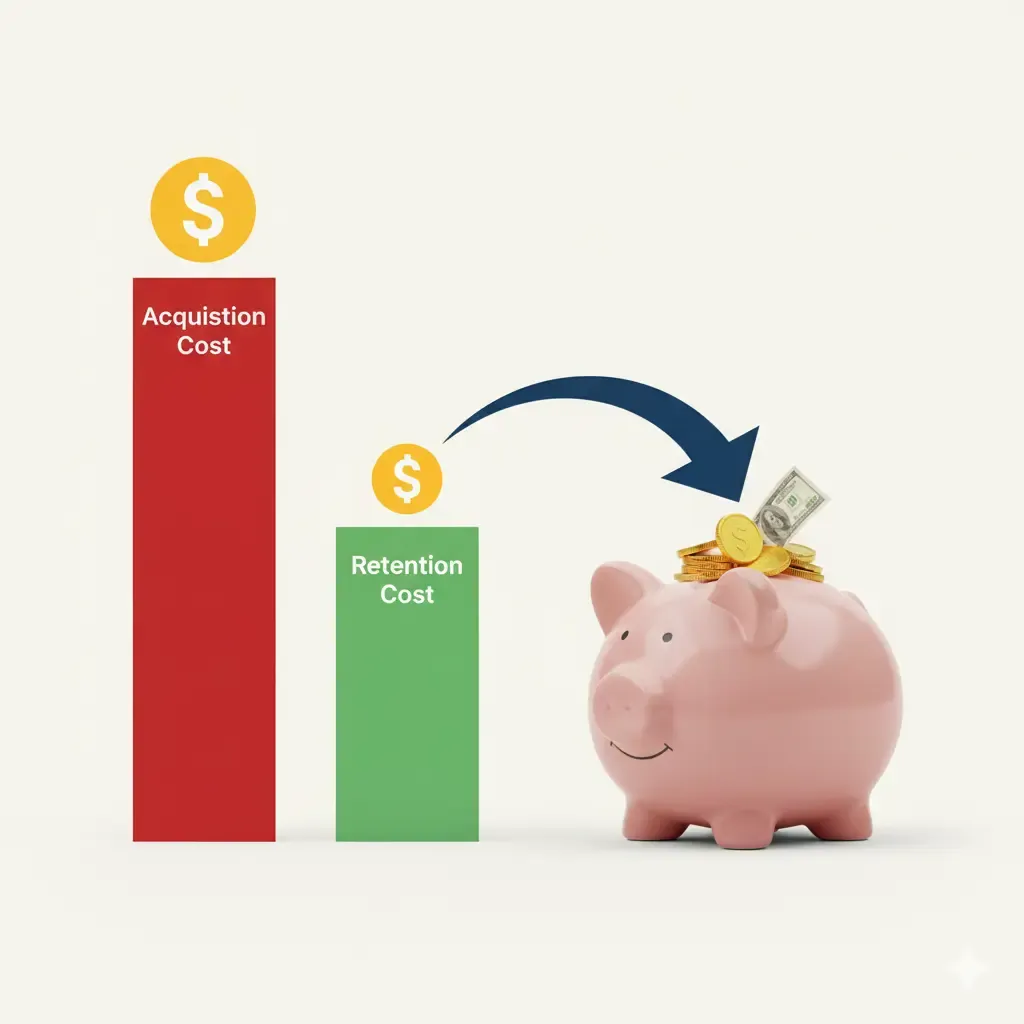
Research consistently shows that acquiring a new customer can cost five to 25 times more than retaining an existing one1. A well-timed cross-selling email costs almost nothing and can yield significant revenue.
🛠️ Scan and Refine: Simple Data for Big Impact
You don't need a data science degree to start. Focus on collecting and acting on simple data. Did the customer do the desired action - like click on a button - or not?
Start by segmenting your first-time buyers using just two variables:
- Revenue Generated
- Value of the first purchase
Targeting the middle is a powerful, yet often overlooked, strategy. The customers who made a medium-value first purchase often have the highest potential for growth. The lowest-value customers may be too price-sensitive, and the highest-value customers may already be maxed out on their first purchase.
A Note on CLV: While Customer Lifetime Value (CLV) is the ultimate metric, using a prediction of CLV to start your marketing efforts can be misleadingly complex. Start with recent transactional data. CLV is best used as a long-term metric to track the success of your post-acquisition strategies, not as a primary segmentation tool for first-time buyers.
📈 Advanced Targeting: Finding Your Best Candidates with Precision
As your business scales, simple "High-Value/Low-Value" customer splits become inefficient. If you treat everyone who bought your most expensive item as the only candidate for your next upselling campaign, you'll likely waste budget on customers who are satisfied for now.
The key is identifying momentum. Which first-time customers are most likely to buy again, and who needs the least amount of convincing?
The "High-Spender Fallacy" (Why the Middle Wins)
Imagine a small furniture company trying to cross-sell accessories. A self-taught marketer might instinctively focus 80% of their budget on the "High-Spenders"—customers who bought the $3,000 executive desk. They assume high past revenue equals high future revenue.
The Hidden Dynamic: Our analysis, powered by tools like Ordinal Regression, often reveals that those high-spenders have a Medium-to-Low propensity to buy again soon. They are "all-in" and satisfied.
Instead, the customers who purchased the $500 starter bundle (the Middle revenue group) show the highest Medium-to-High propensity score. They are actively setting up their space and are open to quick, complementary purchases. By focusing the cross-selling effort on this specific middle segment, the furniture company achieves a 15% higher conversion rate while spending less overall.
Beyond Binary Usage: The Power of Granularity
Another crucial mistake is treating usage as a simple "Yes/No" metric.
Consider a gourmet cooking subscription box trying to convert three-month trial subscribers to an annual plan. A basic marketer might send an upselling campaign to everyone who simply "logged into the recipe portal once."
The Precision Advantage: Our methodology integrates multiple data points—logins, recipe views, time spent, specific ingredient reviews—to assign a Usage Intensity Score (Low, Medium, or High). This score feeds our model to predict annual plan conversion.
We find the two extremes are poor targets:
- High Usage: They will likely convert anyway. Giving them a deep discount means sacrificing margin needlessly.
- Low Usage: They are barely engaged and are unlikely to convert regardless of the offer.
By triggering a high-value incentive only for the Medium Usage Intensity group—the ones on the fence who need a final, timely push—the subscription service can triple the ROI of their incentive spend. This is how you use data to drive profitable conversion marketing, focusing your budget where it has the most influence.
Don't let your hard-won customers leak out of your funnel. Start applying precision to your post-acquisition marketing strategy today, and watch your business thrive on the foundation of profitable repeat sales.
Footnotes
1. Gallo, A. (2014, October 29). The value of keeping the right customers. Harvard Business Review. https://hbr.org/2014/10/the-value-of-keeping-the-right-customers