Turning Interest into Income: A Deep Dive into Conversion Optimization in a Multichannel World
Learn how to transform customer interest into sales using advanced conversion optimization strategies. Master the consumer decision process and thrive in a multichannel shopping environment.
Why Interest Isn't Enough: Breaking Through the Barrier to Conversion Rate Success
As a small business owner, you're likely familiar with the AIDA model: Awareness, Interest, Desire, and Action. Generating Interest—getting customers to read your emails, click your ads, or browse your store—is a monumental achievement. But sometimes, that's where the journey stalls. A customer spends time on your site, adds an item to their cart, and... leaves.
This is the "interest barrier." Your marketing has succeeded in generating heightened interest and consideration, but the final, desirable event—a conversion (a purchase, a lead submission, community engagement)—remains elusive.
So what? Your goal isn't just to be seen; it's to be chosen. The difference between a thriving business and one that's just treading water often comes down to your conversion optimization efforts—the systematic process of increasing the percentage of website visitors or store browsers who take the desired action.
🔍 KYC: Know Your Customer, Optimize the Journey
Before you can break through the interest barrier, you must understand who you are trying to reach.
Expert Insight: According to a study by McKinsey, personalized customer experiences can drive 10–15% revenue growth1.
You must move beyond simple demographics and truly Know Your Customer (KYC). By creating detailed personas or archetypes based on past purchasing behavior, engagement patterns, and demographics, you can better anticipate their needs and design your customer touch points to align perfectly with their decision-making process.
For example, the "Value-Driven Shopper" might need clear pricing comparisons and visible reviews, while the "Tech-Savvy Early Adopter" needs detailed product specs and information on community forums.
🧠 Decoding the Customer Mind: The Consumer Decision Process
To optimize conversion, you must align your strategy with how customers actually make choices. Using a framework adapted from Engel, Kollat, and Blackwell2, we can map out this complex journey:
- Problem Recognition: The customer realizes a need (e.g., "I need a new pair of running shoes").
- Search for Understanding Product Space (Information Search): They look internally (memory, experience) and externally (Google, friends, reviews).
- Conversion Tactic: Be everywhere your customer is searching, with clear, authoritative content.
- Search for Alternative Valuation (Evaluation): They compare options based on their Beliefs (product features), Attitudes (overall feeling toward a brand), and Intentions (likelihood of buying).
- Conversion Tactic: This is where you leverage your value proposition, social proof (reviews, testimonials), and clear competitive differentiators to solidify a positive Attitude.
- Purchase: The decision is made, heavily influenced by their Intentions and factors like the Online Environment (Web Site Quality, Interface) or Situational Factors (convenience, availability).
- Conversion Tactic: Conversion Rate hinges on minimizing friction: one-click purchasing, clear shipping policies, and multiple payment options.
- Outcomes (Post-Purchase): This leads to Satisfaction/Dissatisfaction, or potentially Cognitive Dissonance (buyer’s remorse).
- Conversion Tactic: Excellent customer service and follow-up communication can reduce dissonance and drive repeat business (another form of conversion!).
The Hidden Dynamic: Notice the external factors (Individual Characteristics, Social Influences, Situational Factors) constantly feed back into the decision process. Your marketing efforts, especially those focused on community and social proof, aren't just one-off tactics; they shape a customer's fundamental Beliefs and Attitudes about your brand over time.
🌐 The Multichannel Maze: Adapting to Multichannel Shopping
The decision framework is complicated further by today's multichannel shopping reality. A customer's journey involves simultaneous interactions with multiple channels and firms3.
Upsides and Downsides for Retailers
| Feature | Upsides for Retailers | Downsides for Retailers |
| Reach | Access to more market segments. | Increased complexity in inventory and logistics management. |
| Data | More customer touch points generate richer data for personalization. | Data silos if systems aren't integrated (e.g., in-store sales vs. online analytics). |
| Experience | Can create a seamless, integrated brand story (Omnichannel). | Risk of a disjointed or inconsistent customer experience across channels. |
| Conversion | More opportunities for soft and hard conversions. | Higher cost of maintaining multiple infrastructures (staff, websites, stores). |
Channel Comparison: Online vs. In-Person
| Channel | Pros (Conversion Advantage) | Cons (Conversion Barrier) |
| Online (E-commerce) | Convenience (24/7 shopping), Searchability (easy product comparison), Scalability (low marginal cost per transaction). | Lack of tactile experience, shipping costs/delays, security concerns. |
| In-Person (Brick-and-Mortar) | Sensory experience (touch, feel, try), Instant gratification (take product home immediately), Human interaction (expert advice). | Limited operating hours, geographical restrictions, inventory dependency. |
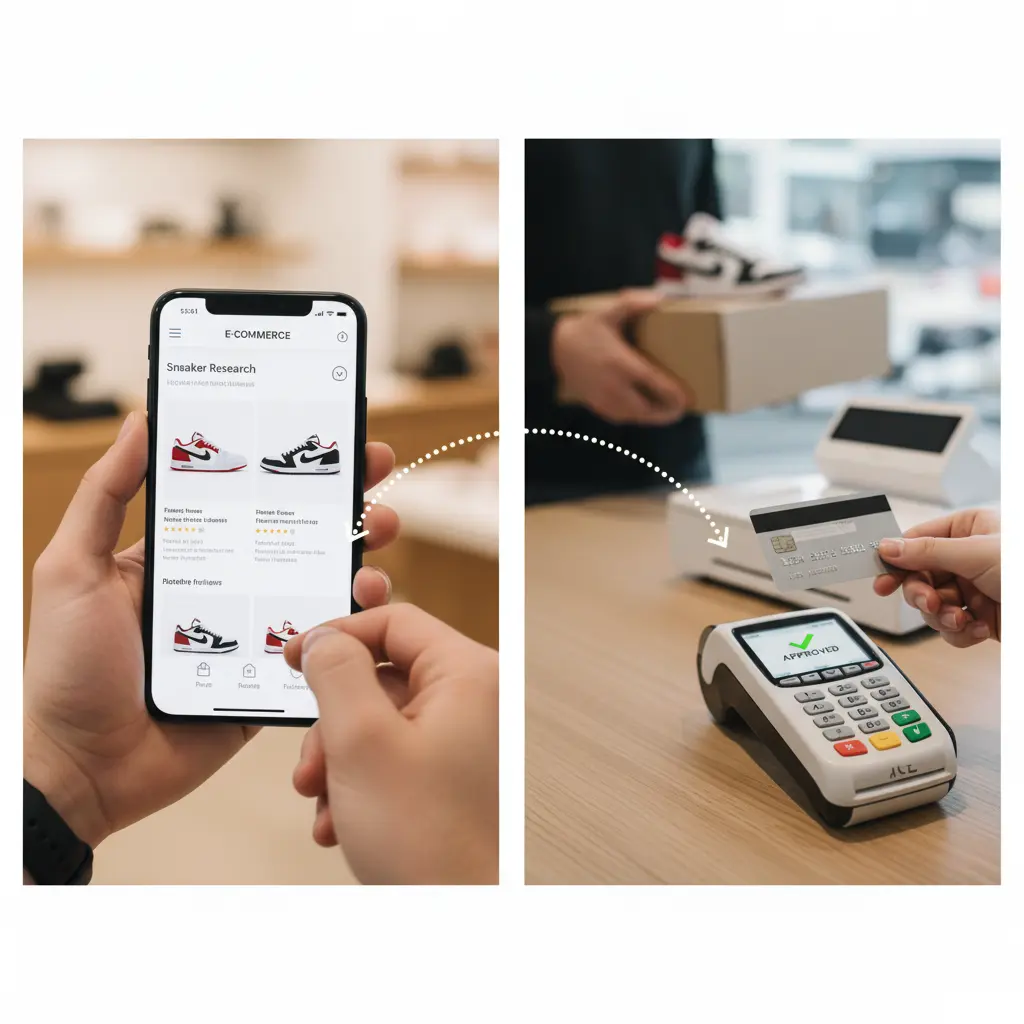
Bottom line: You cannot view your channels as separate entities. The most powerful conversion optimization occurs when you leverage the strengths of each channel to overcome the weaknesses of the other. Example: A customer searches online, reads reviews, and then converts in-store (using the instant gratification advantage).
✅ Best Practices for Multichannel Conversion Success
1. Best Practices for Multichannel Retailing
- Integrated Inventory (Omni-channel): Ensure your online system reflects real-time in-store stock. Offer Buy Online, Pick Up In Store (BOPIS). Actionable Metric: Track BOPIS utilization rate.
- Uniform Pricing and Promotions: Confusion erodes trust. Offer the same deal online and in-store to reduce friction.
- Customer Service Consistency: Allow a customer to start a service conversation on your website chat and continue it with a representative in-store without repeating themselves. This smooths a critical customer touch point.
2. Best Practices for Shopping Websites
Your website is often the ultimate conversion rate engine. Optimize it:
- Speed is Money: A study found that a one-second delay in page load time can result in a 7% reduction in conversions. Use tools like Google PageSpeed Insights.
- High-Quality Visuals: Since the customer can’t touch the product, your images and videos must compensate. Use multiple angles and a sizing guide.
- Review Management: Make social proof prominent. Display a clear average rating and allow filtering. It addresses the "Alternative Valuation" stage head-on.
- Frictionless Checkout: Implement one-page or guest checkout. Remove navigation options during checkout to minimize distractions and guide the customer to the final Purchase step.
📈 Measuring Conversion in a Multi-Channel Reality
In a complex world, how do you measure conversion rate? You must adopt a weighted, multi-touch attribution model.
Conversion Rate = Desired Actions / Total Visitors or Engagements
- For E-commerce: This is simple: Purchases / Website Sessions
- For Multichannel: You need a Customer Relationship Management (CRM) system that tracks activity across channels and assigns a value (or weight) to each interaction. See the sample weighting framework in the table below:
| Channel Interaction | Weight (Value to Final Sale) |
| First website visit (Awareness) | 10% |
| Read 3+ blog posts (Interest) | 20% |
| Clicked a personalized email coupon (Desire/Intention) | 30% |
| Final In-Store Purchase (Action) | 40% |
| Total Sale Value | 100% |
Actionable Step: Implement a CRM that allows you to track customer IDs from your website (via email signups or accounts) to your Point of Sale (POS) system. This gives you a truly holistic, measurable conversion rate across all customer touch points.
Footnotes and Citations
- McKinsey & Company. (2023, May 30). What is personalization?
- Engel, J. F., Kollat, D. T., & Blackwell, R. D. (1968, later revisions including 1978 and the model adapted by Miniard in 1986). Consumer Behavior.
- Neslin, S. A., Grewal, D., Leghorn, R., Shankar, V., Teerling, M. L., Thomas, J. S., & Verhoef, P. C. (2006). Challenges and opportunities in multichannel customer management. Journal of Service Research, 9(2), 95-111. (The attached diagram is a representation of this foundational work).